Monday, January 31, 2011

Cavalry in History - The Cataphract

Because you asked... :-)


Pictured above is a recreation of a Sassanian Cataphract from roughly the mid-2nd Century AD. The Sassanians were the successors to the Parthians and were located on the Eastern border of the Roman Empire in what is today Jordan/Iraq/Iran and as such were a formidible foe and a constant threat to the Roman position in the East.

The term "Cataphract" in English is derived from the Greek: κατάφρακτος Kataphraktos (plural: κατάφρακτοι Kataphraktoi), literally meaning "armored" or "completely enclosed". Historically the cataphract was a very heavily armored horseman, with both the rider and horse covered from head-to-toe in scale armor, while typically wielding a kontos or lance as their weapon.

In response to the Sassanid threat, the Romans eventually created cataphract units of their own and later also armed them with a short bow to deal with the light horse archers which were typically used in conjunction with the Cataphracts. By using the Cataphracts in conjunction with lightly-armored horse archers, the Sassanids were able to create a fast-moving cavalry force that combined firepower with mobility. The only real weak spots were that the Sassanids lacked any infantry capable of holding fixed positions (at least outside of fortified towns.

One slang term of the period that was used for Cataphracts was the Latin word "clibinari" or metal oven which referred to the effect of the armor in the desert heat...I don't think I up for giving this a try with Max! :-)

Sunday, January 30, 2011

On the Trail - Ahmanson Ranch

Today, a friend and I trailered our horses over th Ahmanson Ranch for a trail ride. I've been here before last Fall but I really haven't been out on the trail for extended periods since Max's leg and knee problems so I was looking forward to this with anticipation (and a little trepidation).

Ahmanson Ranch is relatively close to my friend's house and it's about a 45-minute drive from my stable but it's another world apart. Located at the edge of the West San Fernando Valley, it's a refreshing contrast to the urban sprawal and over-development and thanks to a hard-fought battle by various public interest groups and the public in general, it was saved from development (multi-million dollar homes and the usual BS). Click Here for some background information.

For a nice map of the trails, click Here for a map of the area.

One of the reasons I really like this area is that the trails are optimal for horses- no rocks, good footing, fairly wide trails, and long open stretches for trotting and cantering. And lots of grass for your horse to snack on. In short, horse paradise. Also, it really gives you a good idea of what a lot of California USED to look like, once upon a time.

There are two ways to access the area, one from the East off of Victory Blvd. (at the extreme West end) or from Las Virgenes Road on the West side. The East side is more accessible for horse trailers and closer to where we're located so we used that one.

After arriving and paying a nominal $3 parking fee, we tacked up and were soon on the trail. There's a large number of hikers and joggers on the main central trail and some mountain bikes but everyone was polite and there were no issues. Also, Max is getting much better around bikes so it's not as bad an issue that it once was.

Footing on the trail was good although a bit hard from having dried out from the recent rains we've had here. We made our way Northwest and after warming up for about 20 minutes at the walk, we trotted for some stretches. Max is slower than my friend's horse and tends to be more of a follower so my friend took the lead for most of this. On the trot and canter, Max exerts himself trying to keep up and sometimes gets a tad excited so I have to check him once in awhile to get his attention.

We followed the central main trail all the way to Las Virgenes Road and then took a trail that wung around to the East in a large loop. Overall, we estimated that the total trails we rode was about 6 miles or so.

We finally cantered for some long stretches and Max was defnitely game although he'd tend to give a little buck-out when I'd send him into a canter (Max tends to do this when he's exuberant) but it's easy to settle him down. This is the first long trail ride that I've ridden using the Pelham bit and I found it useful for getting Max's attention when needed- the curb effect acts as sort of a "HEY BUDDY, PAY ATTENTION!" when needed (not too hard though).

By the end I had Max in a full fun and he was defintely moving out trying to keep up with his trail buddy (my friend's horse and Max are very attached and I've found that he trailers better when he's with the other horse). After cooling down Max at the walk, we finally made our way back to the trailer. Max was completely coveed in sweat and he'd definitely gotten a good workout. :-)

This is probably one of the best trail rides I've ever taken and while it was only about three hours, it was a good workout for both Max and I and there appeared to be no leg issues. The Pelham bit seemed to have served it's purpose well and although we we need to work on the canter departs a bit with Max's "whoop-de-whoop" buckiing-out, it was still fine. Finally, when we got back to the stables, I made sure to give Max a dose of Bute along with his usual bucket of A&M, Omolene 200 and gloucosamine supplement.

I'll defintely be back soon! :-)

Heading back in a loop towards the start point.

Looking Northwest towards Las Virgenes Road. If you go far enough North, you will hit Chesebrough Canyon. If you go more West, you can eventually link up with trails that will take you towards Malibu Creek State Park (but it will be a LONG ride and you'll have to pass over some seriously paved streets to get over the 101 Freeway.

Looking Southeast towards the West San Fernando Valley. Once upon a time, before the developers screwed everything up, a lot of the Valley was like the foreground- I remember the last of it growing up in the West Valley. Jeeze, I was born 30 years too late!

Friday, January 28, 2011

Tent Pegging and Other Fun Stuff

Here's an interesting YouTube video that a friend passed along to me. Tent-pegging is a traditional equestrian game invented by bored cavalry troopers in the British Army during the 19th Century (at least that's my take on it) and it requires a high degree of skill. Although the target appear to be more like pieces of wood rather than normal tent pegs (which are smaller), they're still a challenge to hit. I've done some of this with old dishtowels (I know, pretty sad but that's all we could improvise at the time)/ I'd like to get into it more someday. I think Max would be pretty game for it. :-)

Thursday, January 27, 2011

...and beer for my horses...

This one has always been a favorite with me...especially the "beer for my horses" part!

Wednesday, January 26, 2011

Before there Were "Horses" - The Hyracotherium

OK, a little history and science on the origins of the horse. Pictured below is a picture of the Hyracotherium, one of the precursors of the horse. Here's some information, courtesy of Wikipedia:

Hyracotherium averaged two feet (60-cm) in length and eight to 14-inches (20-cm) high at the shoulder and weighed about 50 pounds. It had four hoofed toes on each front foot and three hoofed toes on each hind foot. Each toe had a pad on its underside, similar to those of a dog. It had a primitive, short face with eye sockets in the middle and a short diastema (the space between the front teeth and the cheek teeth). The skull was long, having 44 low-crowned teeth. Although it had low-crowned teeth, the beginnings of the characteristic horse-like ridges on the molars can be seen. Hyracotherium is believed to have been a browsing herbivore that ate primarily soft leaves as well as some fruits and nuts and plant shoots.


Tuesday, January 25, 2011

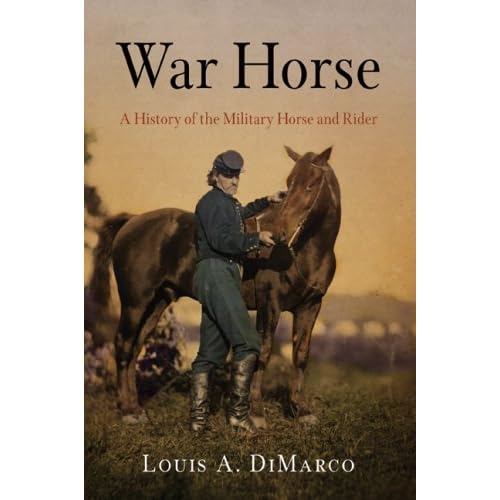
Book Recommendation - The Warhorse

Just to put in a plug for War Horse: A History of the Military Horse and Rider by Louis A. Dimarco.

This book is essentially a history of cavalry from the perspective of the horse and rider and as such is a nuts-and-bolts survey of how cavalry as a military force developed and what it meant for the individual rider. Dimarco's survey is a bit "broad brush" in that it provides a broad overview (it covers cavalry from the beginning of time until its final demise in the mid-2oth Century). Overall, it's a pretty fast read and there's a lot of information. The best past is that it ties the horse in a historical context. I highly recommend it for anyone interested in the role of the horse in military history.


Here's a more detailed description, courtesy of Amazon.com:

For more than four thousand years, the horse and rider have been an integral part of warfare. Armed with weapons and accessories ranging from a simple javelin to the hand-held laser designator, the horse and rider have fought from the steppes of central Asia to the plains of North America. Understanding the employment of the military horse is key to understanding the successes and the limitations of military operations and campaigns throughout history.

Over the centuries, horses have been used to pull chariots, support armor-laden knights, move scouts rapidly over harsh terrain, and carry waves of tightly formed cavalry. In War Horse: A History of the Military Horse and Rider, Louis A. DiMarco discusses all of the uses of horses in battle, including the Greek, Persian, and Roman cavalry, the medieval knight and his mount, the horse warriors—Huns, Mongols, Arabs, and Cossacks—the mounted formations of Frederick the Great and Napoleon, and mounted unconventional fighters, such as American Indians, the Boers, and partisans during World War II. The book also covers the weapons and forces which were developed to oppose horsemen, including longbowmen, pike armies, cannon, muskets, and machine guns.
The development of organizations and tactics are addressed beginning with those
of the chariot armies and traced through the evolution of cavalry formations
from Alexander the Great to the Red Army of World War II.

In addition, the author examines the training and equipping of the rider and details the types of horses used as military mounts at different points in history, the breeding systems that produced those horses, and the techniques used to train and control them. Finally, the book reviews the importance of the horse and rider to battle and military operations throughout history, and concludes with a survey of the current military use of horses. War Horse is a comprehensive look at this oldest and most important aspect of military history, the relationship between human and animal, a weapons system that has been central to warfare longer than any other.

Drivers- Watch out for Horses!

Wish we had this here in California: