Sunday, January 24, 2010

Collection Continues...

Lately it seems that I've been on this strange desire to delve into dressage in a big way (for me anyway) and especially collection.

Today Max and I took our customary weekly lesson and naturally the focus of the training was on various aspects of collection at the walk, trot and canter. Also, attention was paid to transitions between all three gaits with the focus on SMOOTHLY making those transitions and maintaining a seat on the vertical- I sometimes have a tendency to shift forward.

While working on collection at the trot and especially at the canter, for the first time I REALLY felt/experienced what it means to have a horse shift their weight onto the haunches. It's a weird feeling and if you didn't know what was going on, you would think something weird/bad is going on- in some instances it almost feels like the horse is literally falling apart.

The think that never fails to blow my mind here is that Max and I are getting to the point where in many instances Max VOLUNTARILY begins to collect up with little urging on my part. I can guarantee that NO amount of muscling on the reins or other force on my part is going to force Max to do what he's doing- it's all coming from him.

Now this by no means absolves me of my responsibilities as a rider and in fact, it demands even greater attention and physical effort- the rider cannot just sit and ride their way through- they have to actively ride this. What's also key is that I have to constantly ensure that my seat is correct- most of the time this means being on the vertical (i.e., I'm sitting perpendicular to the horse's back)and allowing my body or legs to swing forward (it's so easy to do), especially when collecting at the canter.

While collecting at the canter, as the horse collects up, the front of the horse seems to grow a little taller and the haunches drop down (duh!) and my tendency is to follow the horse's front with my body so that I'm leaning forward of the vertical. Naturally, this may seem to be the right thing but it's not and I have to constantly remind myself. Moreover, because the half-halts require "tucking" your pelvis underneath you (the best analogy, and it's a bit crude, is imaging having a hard bowel movement- yeah gross, but it's it the only analogy that works, at least for me). By allowing yourself to move forward, your actually lifting your rear off the saddle and thus you can't engage in complete half-halts.

As a final note, I've also begun to be more aware of just what my body is supposed to be doing in half-halt- it's almost like coiling oneself a like spring in the shape of a "c" with the pelvis being one end and the diaphragm being the other. You really learn to use those muscles!

Although I don't pretend to be any sort of an expert and I'm sure that I've missed a lot of technical points, I do find it amazing, especially since most of the people who do this started at a very young age and I started WAY later.

Finally, I also think Max is getting better at this and there's been times where he's now collecting spontaneously while trotting and cantering (at times when I don't necessarily want it)- very interesting! :-)

Saturday, January 23, 2010

Back on the Trail

After a week of rain, things finally cleared out and slowly the ground has begun to dry. The downside is that it's been very cold at night and even during the day it was a bit crisp...the end result was something that's not normally seen here in this part of Southern California: SNOW!

Needless to say, I had to get Max out on the trail again and so I decided to scout out some of the storm damage. I avoided low-lying areas since there's still a lot of water and the attendant risk of quicksand. Also, any of the usual stream crossings in the Hansen Dam Basin are going to be higher than usual with a fast current (all the run-off from the mountains). My area to ride in was going to be somewhat limited.

I rode down the wash and except for fast moving water in the stream, it wasn't too much of a problem. When I rode under the Foothill Blvd. and 210 bridges, I noticed that the stream was only running on one side and it was fairly easy to cross so I could have accessed a fairly large area of the basin in either direction.

I decided to go towards the Equestrian Center and Gabriellano Park, working my way around the Equestrian Center and then heading east on the Haul Road. I then took a loop home that took me past the Park (where I decided to work Max some). Finally, I made my way up Orcas Ave. towards the stables.

Overall, there was the usual sort of earth movement and the run-off had deposited a large amount of ash from last August's Station Fire. There streams running through the basin had definitely expanded so it's going to be awhile before I get down there. I took a few pictures with my cell phone- not the best camera, it was more beautiful in person.

Max did pretty well and he was eager to get out after a week in his stall but he wasn't crazy. Working him out in the Gabriellano Park was definitely a good idea and we even reviewed some basic dressage moves and collection. Hopefully the weather will stay relatively clear for awhile (although another storm is supposed to be coming on Monday- we'll see) so I can get back to working Max.


Little Tujunga Canyon


Haul Road looking east


Looking east from Gabriellano Park


Big Tujunga Canyon, looking northeast


Another view of Big Tujunga Canyon, looking northeast

Friday, January 22, 2010

Infantry vs Cavalry

Some thoughts on the old "Infantry vs Cavalry" debate:

1) Horsemanship- The state of horsemanship was abysmal. For the most part, there was no formal instruction and it was up to the individual companies to train. With motivated/competant officers and NCOs, results could be achieved in time but to a great degree, training was of the character of "on the job", especially if the company was going on campaign (before departing, companies were reinforced with new recruits, some who had just barely enlisted).

2) Logistics- A good part of the horse's normal garrison ration was grain. Out in the field, supplies were spotty and for the most part the horses depended on grazing the local grass. After three or four weeks of campaigning, horses frequently broke down and if nothing else, lost a lot of weight. The horse breeds used by the Indians were far more hardy and capable of subsisting on a lot less. In fact, it could be argued that the march rates after three or four weeks were actually more favorable for infantry.

The reality was that for the most part, the cavalry was incapable of catching up with Indian war parties, who operated mostly in the Spring and Summer. The key strategy that Miles employed was the winter campaign when forage for the horses was hard to find and limited food supplies. Snow and severe rain limited mobility and especially with the women and children. Basically the Indian villages were "fixed" during the winter, making them a target. Miles basically gutted the Sioux with the 5th Infantry in the Fall of 1876/Winter of 1877.

IMHO, much of what we see and hear of the infantry vs cavalry debate is tainted by a combination of officers attempting to save their careers and justify their actions after-the-fact and later with Hollywood movies and just plain BS. The record is fairly mixed and I believe that both cavalry and infantry were essential, cavalry to provided a wide-ranging "presence" and the infantry to act as the proverbial "rock" to anchor a campaign.

Thursday, January 21, 2010

The 1870s Walk-A-Heap

One of my interests has always been the military side of things in the Old West and especially things that people don't usually associate with the West such as infantry. When it comes to living history, people often only think about Custer and the 7th Cavalry and that unfortunate encounter at the Little Big Horn. This ignores 99% of what else was out there and contrary to Hollywood movies, bad novels and other media, infantry played a key role in the Army's campaigns during the Indian Wars.

I originally posted this on another living history board but I thought that it might be of interest here...and yes, believe it not, there actually WAS infantry in the West and they were often more useful than cavalry for heavy campaigning. :-)

The following is some general information for those who would like to put together an 1870s infantry impression so here's a brief overview:

First, you have to ask yourself what year are you portraying? Uniforms and equipment were in a state of flux during this era and often times key items were different from year to year. Contrary to popular belief, soldiers were not simply issued with leftovers from the Civil War (in fact, it was due to poor storage that a lot of these items were rendered unuseable which prompted the Army to seek replacements).

With that said, I'll start with the necessary kit for an 1876 impression:

1874 Sack Coat w/ branch of service trim on the sleeves. This was a four-button sack coat, unlike its Civil War cousin.

1872 Trousers or Civil War era trousers (preferably Schuykil pattern). There is very little difference between them and both were used.

1851 or 1872 Shoe (aka brogans). Both appear to have been used throughout the 1870s and the 1872 model was made with copper screws which in turn made them especially unforfortable in the winter.

1872 Forage Cap with appropriate branch of service, company and regiment brass. These are arranged a bit differently before and after 1875.

Campaign Hat- At this point there was no official issue model (in 1877 there would be) and the soldiers bought these from the post trader or other civilian source. These would be non-descript slouch hats in a variety of colors, mostly black, brown and grey. One note: DO NOT PUT HAT BRASS OR HAT CORDS ON THESE!!! The actual soldiers rarely did so (and it wasn't authorized) and it will mark you as a farb.

1873 Greatcoat- This was a pretty warm garment and was blanket-lined and had a double-cape.

1874 Canteen- This would be a converted Civil War era canteen and there were at least two different models.

1874 Haversack- This came in two basic models, the earlier in cotton duck with a tarred cover and a later one with a thick canvas cover.

1874 Meat Can- The Army's first attempt at an issue piece of mess wear. Descendents of this basic model were used by the Army up until the late 1980s.

1874 Knife, Spoon, and Fork- Once again, the Army's first official issue eating wear. Before this, soldiers bought whatever they could at the post trader.

1874 Cup. Similar to it's Civil War cousin in size and configuration. Unlike those in the Civil War soldiers did not install wire bales and efforts were made to keep these clean (from what I can tell from the research I've done).

1874 Clothing Bag- Rarely carried on campaign, this was intended as a means carrying clothing and along with the haversack, made up the Palmer Brace System.

Blanket- Can be either the Grey pattern found in the Civil War or the later 1873 model with purple stripes (yeah, purple! ).

Gum Blanket- Same as it's Civil War predecessor (it was the same item).

Shelter Half- Identical to the Civil War model, mostly the 1864 model. Wooden stakes simliar to those found in WWI/WWII were also issued along with two-piece poles.

Prairie Belt- This was the ammo belt consisting of loops. At this time there was no official issue item like this so soldiers would purchase their own from either civilian sources or from one of the Post saddlers. Old 1851 waist belts and NOC belt buckles were popular for conversions. By 1877/78, the Army finally developed it's own issue belt.

1874 belt and McKeever Pouch. These were garrison items and along with the haversack and clothing bag made up the Palmer Brace System.

Bayonet and Scabbard. The Bayonet scabbard was developed in 1872 and the bayonet was usually a converted Civil War era bayonet (althogh there some bayonets specially made for the 1873 Springfield Rifle. The bayonet was also a garrison item and was left behind on campaign.

The above is only a rough sketch and I'm partially going off memory here so I might have gotten a few things wrong so please bear with me. Also, while it can be successfully argued that it took time for items to be put into the Army supply system and distributed to the troops out West, the process still occurred in a reasonable amount of time so using this as an excuse to use Civil War stuff really doesn't cut it.

Also, and this is a gripe of mine, all too often the "it took time to issue new items" is used as a cop-out by people to weasel out of having to expend the money and time to procure the right stuff- in some cases, it simply doesn't work and makes you look like a farb. Also, while in some instances you can justify the Civil War item, in order to really set the Indian Wars impression apart from Civil War, you really have to use the stuff that's unique to the 1870s to really stand out. Just my opinion there.

Unfortuantely, there are way too many half-assed Indian Wars infantry impressions out there (and don't get me started on cavalry) and they're not even good Civil War impressions. LEAVE THE CIVIL WAR BEHIND! OK, that's my dos centavos on that matter.

Also, just an observation: While it's easier to put together a c. 1867 impression using mostly Civil War items, procuring the 1866 Springfield (aka Second Allen) is a killer- apparently the prices have gone through the ceiling.

On the other hand, doing a more latter impression such as the later 1870s or 1880s is easier from a weapons standpoint (though not much with the prices), getting the proper unifroms and equipment is a bit more of a challenge.

Finally, the one thing really holding back things is the lack of a good uniform vendor. The only game in town is the Quartermaster Shop and the authenticity of some of their items is pretty questionable (although the workmanship is pretty decent). Perhaps things have changed but at least that's what I encountered about four or five years ago.

Just my dos centavos but I hope people find it helpful.

Wednesday, January 20, 2010

Uniforms, Arms, and Equipment: The U.S. Army on the Western Frontier 1880-1892


Here's something people here might be interested in. I previously posted elsewhere in regard to Douglas McChristian's new book, Uniforms, Arms, and Equipment: The U.S. Army on the Western Frontier 1880-1892.

Although this two-volume set has been out for awhile, the price tag has been a bit of a deterrent to me until now (it was a birthday gift)...I just bought and I have to say the volume of information is overwhelming!

This set is a follow-on to McChristian's earlier book which focused on the Army from 1870-1880 and it surpasses his earler work both for scope and depth. There's a lot of stuff I never knew about or was confused about and this book has gone a long way to filling in the gaps. I especially found his explaination of the marksmanship badges and how they were earned to be especially interesting.

I've just begun to examine it but I think I can safely say that if you're serious about recreating/reenacting the US Army of the 1880-1892 timeframe, you NEED to get this book. What's also interesting is reading about how some of the items were designed and the personalities of the personnel involved- sometimes, resistance to introducing a new item was simply a matter of "I don't like it, so there!".

McChristian also provides interesting details as to how equipment was marked and he contrasts what the "official" policy was versus what troops did out in the field. The pictures are also an excellent resource.

Monday, January 18, 2010

Max and I Join The Cavalry

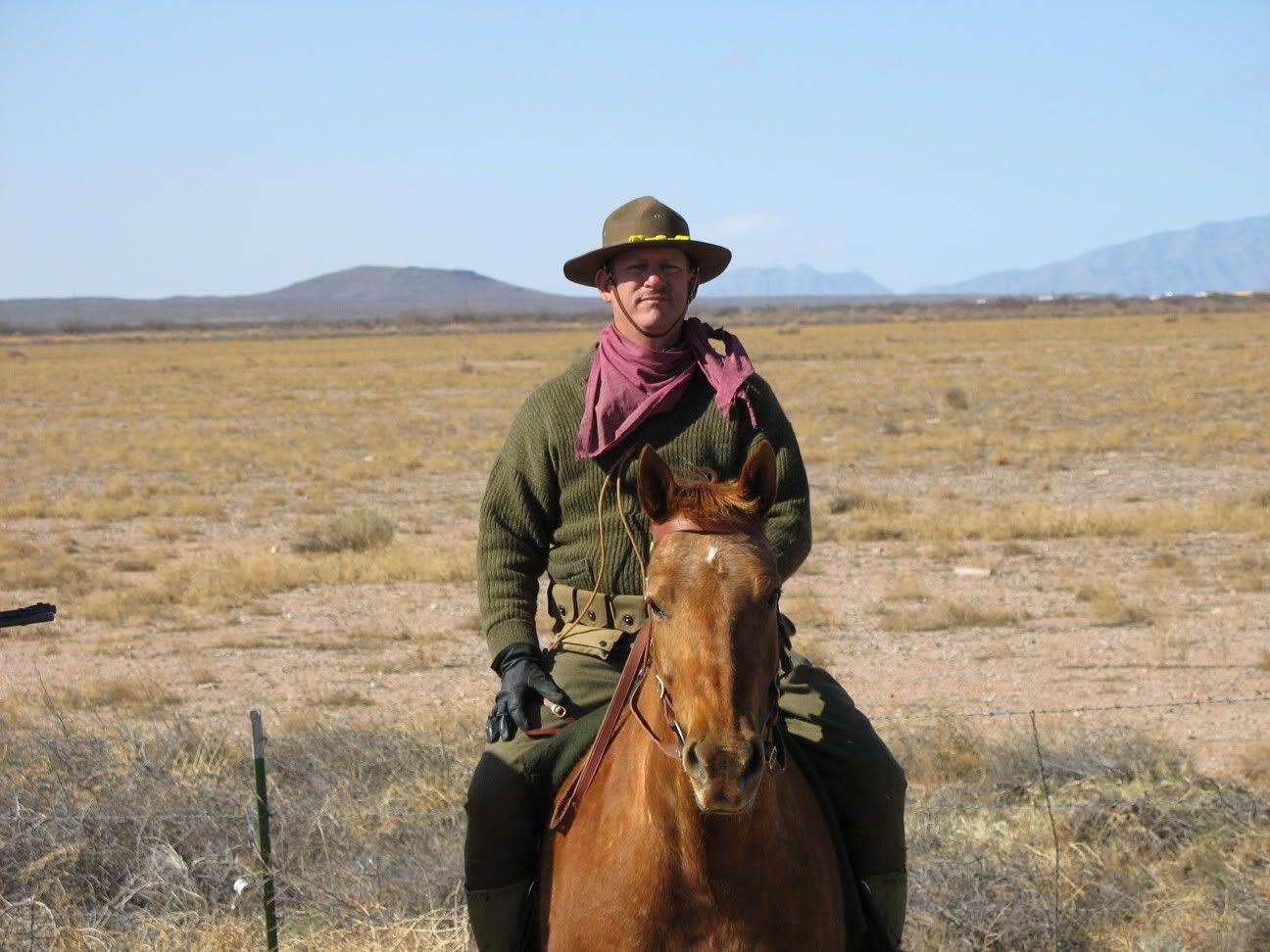
Last weekend Max and I participated in our first Civil War cavalry training event and it was interesting, to say the least. The unit putting on the event is a newly-forming unit, the 7th Ohio Volunteer Cavalry and it was held on a ranch up in Soledad Canyon, not too far away from Vasquez Rocks. The unit itself is a bit of a "work in progress" so this was more of a "meet and greet" than a full-blown training event but it was still a good introduction. After hitching up, Max and I arrived early Saturday morning ready to go. Max trailered with no issues and he soon settled down into his new environment- it was a bit exciting for him but nothing bad.

The unit is a mixed bag of men and horses and many of the people had defected from other units for one reason or another. Apparently, there has not been a real Federal cavalry presence in a long time and the organizer/leader of the 7th Ohio is attempting to change that. For me, I've been away from the Civil War reenactment scene for a good five to six years and it's clear that things have changed quite a bit (I used to go Federal infantry but fell away from it for a variety of reasons to include getting into horses). The level of equitation was a bit mixed with a combination of green and experienced riders and some of the horses were pretty obnoxious- nevertheless, it wasn't a deal-breaker. I view it as a work-in-progress and it kind of reminds me of what I've read about our historical forbearers first forming up in 1861.

We worked on a variety of formations and movements and it was not anything too different from what I do with the Warhorse Foundation practices on Saturdays. I was able to work through the commands and formations fairly easily although Max could sometimes be bit obnoxious. Fortunately, Max is used to bumping butts so he wasn't too concerned about being pushed around in formation; at one point I was stuck next a green rider who couldn't control her horse so I had to keep an eye out for a horse that fish tailed all over the place- Max didn't mind the bumping butts though. No horses fired or tried did anything.

We also worked on weapons handling and this went a little better and people seemed to be very much in control and always conscious about safety (in fact the guy who organized the unit left a Confederate cav unit because of repeated safety violations/issues).For pistol shooting, I approached things a bit cautiously with Max and while I didn't fire off of Max (I suppose I could have but I've learned from bitter experience that rushing things leads to disaster). By the end I was able to place Max between two horses (maybe 2 or 3 feet on each side) with each person firing a half-load pistol charges. Max didn't flinch a bit.

Sword work was pretty decent and by the end I was working with steel- the sword fights are not too different from what Max and I did at Anza. Everything is controlled with safety in mind. The one big rule is that the sword point is to be kept up at all times and don't extend your arm out (i.e. lean out). I was also informed that some of the Rebs can be knuckleheads (nop surprise there) about the swordplay but usually things are fine- if necessary, break off.

One interesting thing about the site where we practiced is that it's in close proximity to train tracks (this is east of the 14 by Vasquez Rocks)so you're constantly hearing the roar of trains passing by. Good thing for de-sensitization. The other thing is that there's a wildlife center (sort of a Wildlife Waystation kind of operation) up the road that houses lions and other wild animals. With the wind blowing from there, the horses could smell (I imagine) the lions this seemed to make some the horses a bit more excited at times. You could also hear roaring throughout the night (at first I thought it was mules braying until I put it all together).

Overall, it was a good start and we'll need to work some more but I think it's got great potential. Moreover, for the first time, I can really get Max out to events and in the long run, this will make him a better horse. We just have to approach the whole thing intelligently and not rush things, especially in the mounted shooting area. More soon.

Below are a few pictures from the event. The ones of me are not the best but oh well...:-)


Tuesday, January 12, 2010

Max in the Movies Again

As a follow-on to the the film work we did back last May, some friends and I were called upon to do perform in the some pick-up shots for a trailer that an aspiring director is filming so he can get financing for the larger picture. I can't really give more specifics than that due to a non-disclosure agreement.

Unlike the last time which involved a large group involved in various fights et al., this involved three riders and we were supposed to be highwaymen/baddies/no-goodnicks racing down a trail. We filmed this close to Gabriellano Park along a trail that I've ridden many times- it's covered by trees. The perfect setting for a chase. It's kind of reminiscent of "The Legend of Sleepy Hollow" and I was half-expecting Christopher Walken to pop out from behind a tree and pursue us on horseback.

I was dressed up in pseudo-18th Century clothes complete with a wig that gave me stringy long hair (I sort of looked like either a roadie in a rock band or pirate, take your pick). It was pretty amusing.

Max and I basically performed in a number of scenes where we're cantering down the forest trail. Max was with horses he's very familiar with and naturally he was a bit excited. Overall, Max was manageable although on several occassions we had to have a discussion on what's acceptable. We were out filming for about three hours and has time passed, Max was definately buzzed up to the point where I'd have to circle him several times before springing into the canter- basically a moving start. After the take, I'd walk Max around to calm him down.

Max was a lot better than when we last filmed in May and hopefully he'll be even better in the future. Although the film shoot wasn't that long, Max definately got a workout so a rest was in order. Naturally, Max got a nice bucket of Omolene and A&M after we got back to the stables. :-)