Wednesday, November 11, 2009

Veteran's Day


Although the above doesn't directly apply to the First World War, I think it applies anyway. This verse is attributed to John Maxwell Edmonds (1875 -1958), and is thought to have been inspired by the epitaph written by Simonides to honour the Greek who fell at the Battle of Thermopylae in 480 BC.

This epitaph is part of the 2nd Division Memorial commemorating those who fell in the Battle of Kohima in 1944. Here's some more detail:

The Kohima 2nd Division Memorial is maintained by the Commonwealth War Graves Commission on behalf of the 2nd Infantry Division. The memorial remembers the Allied dead who repulsed the Japanese 15th Army, a force of 100,000 men, who had invaded India in March 1944 in Operation U-Go. Kohima, the capital of Nagaland was a vital to control of the area and in fierce fighting the Japanese finally withdrew from the area in June of that year.

The Memorial itself consists of a large monolith of Naga stone such as is used to mark the graves of dead Nagas. The stone is set upright on a dressed stone pedestal, the overall height being 15 feet. A small cross is carved at the top of the monolith and below this a bronze panel is inset. The panel bears the inscription:

"When You Go Home, Tell Them Of Us And Say,

For Their Tomorrow, We Gave Our Today"


The words are attributed to John Maxwell Edmonds (1875 -1958), an English Classicist, who had put them together among a collection of 12 epitaphs for World War One, in 1916.

According to the Burma Star Association the words were used for the Kohima Memorial as a suggestion by Major John Etty-Leal, the GSO II of the 2nd Division, another classical scholar.

The verse is thought to have been inspired by the Greek lyric poet Simonides of Ceos (556-468 BC) who wrote after the Battle of Thermopylae in 480 BC:

"Go tell the Spartans, thou that passest by,
That faithful to their precepts here we lie."

Sunday, November 8, 2009

Veterans' Day Parade 2009

This last Saturday, I participated in a Veterans' Day parade in Long Beach as part of the Great War Historical Society. Every year for the past five years or so, we have participated in the Long Beach Veterans' Day Parade (usually on the Saturday closest to November 11). This year, we provided the color guard for the parade and were placed towards the front of the parade.

This year, it seemed that there were far fewer parade participants than there's been in former years and even our group attendance was down- we have a VERY tiny color guard. We usually have people representing all of the combatants and this year we featured some three Americans, one early war Frenchman, two Germans, one Austro-Hungarian sailor, and one Austro-Hungarian soldier. It was a pretty polyglot group. :-)

The parade actually went pretty quick (the parade route isn't that long) and we were done by about 11:30 am.

Overall, it was a nice salute to those who came before and put their lives on the line for this nation.


On the march- not the best picture but still pretty good. We were just reaching the end of the parade (thank god!).


Group shot of the Great War Historical Society


Another group shot...

Friday, October 30, 2009

Working with Max

With having classes three days a week (more about that later), my time with Max has been somewhat limited so my riding days are usually Saturday, Sunday, Thursday and occassinally Monday (depending on how the furlough day falls).

Of late, I've been working a lot on making Max more sensitive to my leg in general and working on my transitions and collection. It hasn't been easy but it seems that Max is coming along although he does have his days. Usually it takes a few minutes to get Max sufficiently "woken up" so he's paying attention and not just going through the motions (he's good at BSing his way through work if you let him).

Also, I've been working hard on collecting up Max and making him work on his haunches more. Sometimes it's really tough and he doesn't seem to readily get the message- this is especially noticeable in collected canters. No doubt, it's more about where I'm positioning my body than anything else but sometimes it feels like I'm holding him in with tight reins against the bit. When things are going well, he seems to pick up on the idea so I don't have to maintain constant pressure or use as much pressure. The key is to not use any at all except for a light contact.

I guess the best analogy is that when transitionin into a collected canter or trot, it's almost like reeling in a fish and you're progressively shortening the reins and using half halts to collect him up. When everything works right, you can feel the back shorten up and it feels like more "energy" is coming up through you rather than forward. It's a weird feeling and very hard to describe. Sometimes I hit it and sometimes he simply isn't slowing down that easy (hence the use of more pressure). I have to remember to release on the half-halts!

Last night we had a pretty good workout and I focused heavily on transitions, especially between the walk and the trot. I also worked a bit on forcing Max into the extended trot for long periods (typically along the straightaways on the quarter-mile track here at the stables). Max doesn't like the extended trot but I've been having increasing success in making him do it for sustained periods of time and it's pretty awesome when he gets into the groove- we'll make a Standardbred out of him yet! :-)

I also worked on the slow sitting trot and then transitioning between that and the extended trot and the canter. I also made sure that I did this going both ways on the track. Overall, it seemed to have worked out fine. It also helped that the wind has died down considerably and it was cool last night so it put Max in a good frame of mind to work.

I may not be putting in the long hours as I was in the summer but I'm doing what I can to work better with the time I have.

Wednesday, October 21, 2009

Morro Bay 2009

At last!

Somewhat belated but here's a picture of Max adn I at Morro Bay this year. Unfortunately, I don't have a good camera so I'm dependent on the kindness of others and sometimes it takes a bit...but here it is! The day this was taken was a beautiful day and we even managed to gallop down the beach to Morro Rock. Max was quite the horse that day!


Max and I on the beach!

Getting ready to ride out...

On the beach....

Thursday, October 15, 2009

The China Relief Expedition


Here's an interesting painting commissioned by the US Army as part of a series depicting the Army throughout its history. This one is from the China relief Expeidtion (aka The Boxer Rebellion). According to the Army:

By early August most of the allied relief force was committed from Tientsin to relieve the Peking legations, leaving behind, among others, the 6th Cavalry and also some men of the British 1st Bengal Lancers. The troops remaining in Tientsin were to secure the lines of communication and obtain information on Boxer or Chinese Imperial troops in the vicinity. Troop A, 6th Cavalry, under 1st Lt. E. R. Heiberg, "armed with carbines and pistols" was ordered to join a detachment of the 1st Bengal Lancers under Lt. J. R. Gaussen on 15 August for a reconnaissance. The allies were to locate, but not engage, a force of Chinese Imperial troops reported west of Tientsin.

The next morning the combined group left early and, after an uneventful ride of about eight miles, seeing nothing but "undestroyed villages, cornfields, and plowed fields," they came across a village flying red flags, usually a sign of enemy troops. Led by Heiberg and Gaussen, the group moved at a trot in a line of skirmishers with a reserve towards the village. Heiberg then saw what seemed to be two rows of trenches, dismounted carefully to scan them, but again nothing unusual could be seen. The force then advanced to within two hundred yards of the trenches when it came under fire from the front and the right and left flanks. In the confusion the skirmishers retired on the reserve and one of them, Cpl. Rasmus Rasmussen, was thrown from his horse at the point of farthest advance. Heiberg and Gaussen saw Rasmussen lying on the ground near the Chinese trenches. Heiberg's horse became unmanageable, so Gaussen rode on. The Chinese, who had also seen Rasmussen, emerged from their trenches to take him prisoner. The race was on. Lieutenant Gaussen reached Rasmussen first. In Heiberg's words, "Lieutenant Gaussen succeeded in mounting Corporal Rasmussen behind him and rode to the rear. But for the gallant lieutenant, I am quite sure that Rasmussen would have been captured, as he was perhaps less than 250 yards from the trenches, and the enemy had left their trenches after him."

The allied contingent fired dismounted for a short time and then withdrew. They returned home at about 1:00 p.m. "without the loss of a single man or horse." For his bravery during the operations in China, Lieutenant, later Brigadier General, J. R. Gaussen was awarded the China medal with clasp and named Companion of the distinguished Service Order.

The painting shows the moment of Corporal Rasmussen's rescue by Lieutenant Gaussen. Both men are in the khaki uniforms preferred for the relief expedition.

Wednesday, October 14, 2009

More Marching Through History

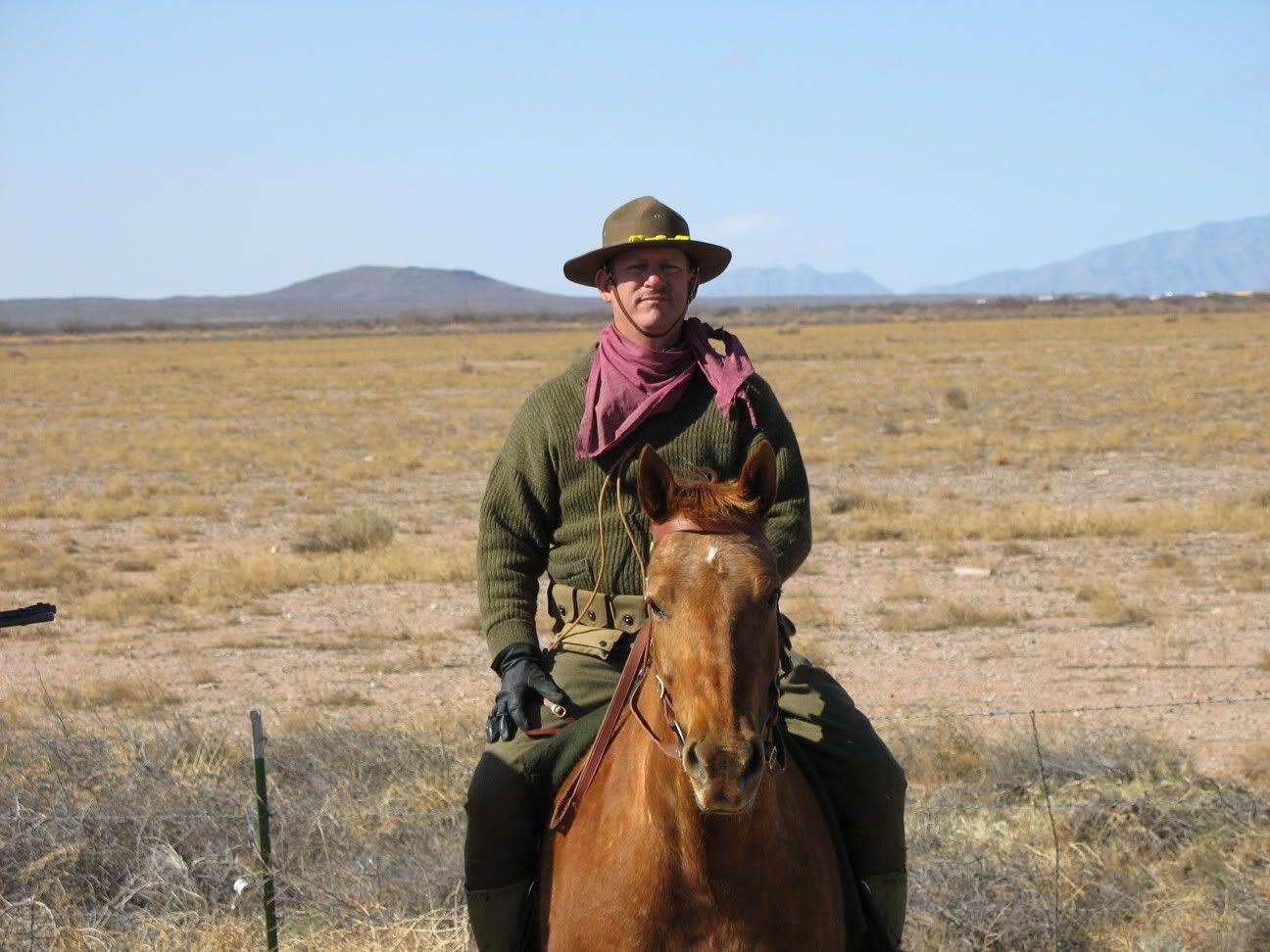
Here's some more pictures from the recent Marching Through History Event that I took Max to a few weeks ago. This was really a major achievement for me and it was five years in the making and required the putting together of a lot of pieces: successful trailering, getting a truck and access to a trailer, getting the necessary saddle and tack for a pre-WWI/WWI US Cavalry impression, getting the necessary personal uniforms and equipment, et al.

The day started off at about 5 am when I left the house. Because I had a social engagement the night before, I was unable to pre-load the tack room in the trailer that I was going to borrow so this would all have to be taken care of in the morning. I managed to load up my personal equipment in the truck the night before (with certain exceptions) so it didn't take too long to get out of the house.

I arrived at the stables at about 5:30 am and then spent the next 20 minutes or so hitching up the trailer, a process made more difficult than usual because of the dark. After several attempts, I managed to hitch the trailer up and make sure that everything was working right. I then had to load up saddles, tack, water, food, and other sundry stuff. It's quite a lot to get ready to transport horses, whether it's one or several.

Finally, after I checked and double-checked that I had everything I'd need (the LAST thing I needed was to leave a bridle or saddle blanket behind!), I proceeded to load Max. That went without a hitch- all the practice and places I've taken Max to since the beginning of the year really paid off!

Finally, after one more check of everything, I departed the stables- 7 am. I then had to stop at a friend's house to pick up a horse for another friend of mine who was already out at the event (he's the guy dressed as a German Uhlan in the pictures). I loaded up the second horse with no issues and finally made my way to the 210 Freeway.

In driving on the freeway, I travelled mostly at the 55 mph speed limit and took everything VERY carefully. Driving while pulling a horse trailer is very different than just driving the truck alone and even other sorts of trailers- for one thing, the center of gravity is much higher because of the horses.

I tested the trailer brakes and everything seemed to be functioning correctly and as I ascended the first set of hills towards La Crescenta, everything seemed fine. When I begain the descent into La Crescenta, the trailer brakes and transmission (the Ford F-250 has a special transmission setting for towing) did their job perfectly.

I slowly made my way down the 210 Freeway and transitioned onto the 134, which ends and Pasadena and becomes the 210- basically it means having to slowly drive through a tunnel and then be prepared to move over three lanes because of disappearing lanes. This can be tricky when the freeway is crowded but it wasn't a problem due to the freeway being empty at 7:30 am on a Saturday morning.

The rest of the journey was uneventful and the trailer brakes and transmission worked excellently as we descended into Pomona. I finally arrived at Prado Regional Park at about 9 am and quickly found a place to park the rig (hopefully no idiots would block me in when the time came to leave at about 5 pm).

I quickly unloaded both horses, tied them up and got hay and water for both of them. Now we were ready for the day...

To be continued...

Max doing what he does best...grazing!

Max and I with our German compadres

Max and I...We're really here at last!!!!


HMS Royal Oak - RIP


On this day in 1939, the battleship HMS Royal Oak sunk by torpedo attack while at anchor in Scapa Flow. RIP.

From Wikipedia:

Torpedoed at anchor by the German submarine U-47 on 14 October 1939. Launched in 1914 and completed in 1916, Royal Oak first saw action at the Battle of Jutland. In peacetime, she served in the Atlantic, ...Home and Mediterranean fleets, coming under accidental attack on more than one occasion. During a twenty-five year career, attempts to modernise Royal Oak could not address her fundamental lack of speed, and by the start of the Second World War, she was no longer suited to front-line duty.Royal Oak was anchored at Scapa Flow in Orkney, Scotland when she became the first of the five Royal Navy battleships and battlecruisers sunk in the Second World War. The loss of life was heavy: of Royal Oak's complement of 1,234 men and boys, 833 were killed that night or died later of their wounds.

For more, go HERE.

My Picture Gallery from Living History Worldwide